
Pandagoo Spreadsheet Lifeboat: an order plan for the day an agent site goes quiet
A product catalogue for browsing, plus a stage-by-stage plan for what to save and whom to contact when a shopping agent stops answering, with Pandagoo as the case on our desk.
Shelves to browse while the agent question gets sorted
Eight shelves first, picked because they make up most hauls by weight. Each card opens a live category of listings.
 Low-top sneakersBoxed shoes set the weight of most parcels
 JacketsBulky when packed, light on the scale
 HoodiesFleece-lined and plain versions often share one menu
 JeansWaist sizes often given in chi or jin
 Crossbody bagsFolds flat, ships cheaply
 T-shirtsFabric weight in grams decides the feel
 HatsEasy to rebuy if an order stalls
 WatchesBatteries can limit the shipping line
Eight more shelves: Sunglasses, Joggers and sweatpants, Jewellery, Women's knitwear, Belts, Perfume, Cables and gadgets, Team kits. Our own notes on unbranded goods from all sixteen shelves, with listing IDs you can keep, sit on the Lifeboat shelf page.
What this Pandagoo Spreadsheet can help you recover
Pandagoo Spreadsheet Lifeboat does two jobs. The first is the usual one for a Spreadsheet site: a catalogue of product listings sorted into sixteen categories, so you can browse goods from Chinese marketplaces and open each listing. The second job is the reason this site exists. Pandagoo, a shopping agent whose site went live in March 2026, has not loaded for us since the last days of that month. Anyone who had money or parcels with it had to work out, alone, what still counted as evidence and who could still help.
The catalogue can help recover a product link; the Lifeboat notes can help organise evidence. This independent site cannot see a balance, cancel an order or move stored goods. Choose the last stage supported by a receipt or tracking event, not the stage you hoped the order had reached.
That problem is not special to one agent. Any service that buys on Taobao, Weidian or 1688 for you holds your money and your goods for weeks at a time. If its site stops answering, what you can do depends almost entirely on how far your order had got. So the core of this site is four pages, one per stage, each with a list of records to keep and an order of contacts. The outage kit builder turns those pages into a personal checklist.
We are not lawyers, and nothing here tells you what you are owed. We describe steps you can take and records worth having when you take them.
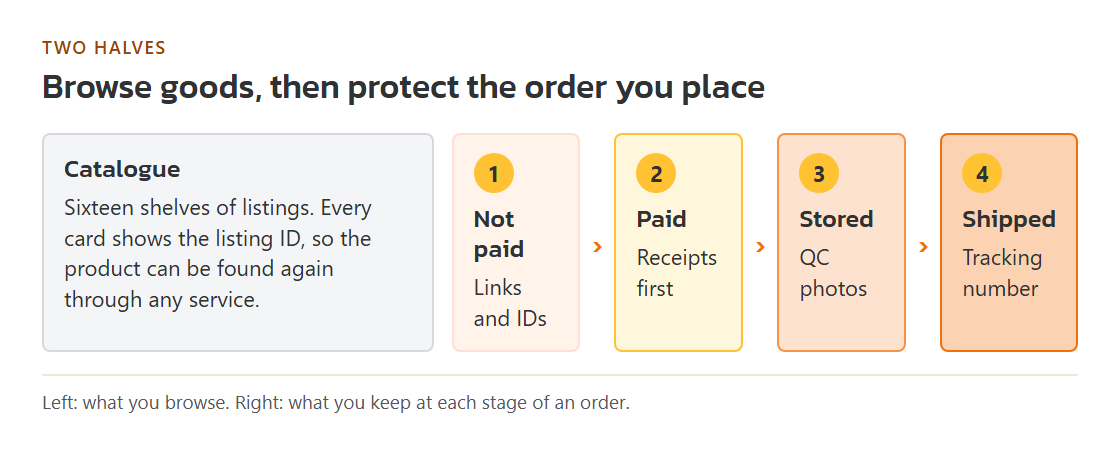
Four stages, four different kinds of exposure
An agent order changes hands three times: your money goes to the agent, the agent pays the seller, and the seller's parcel reaches a warehouse that later hands a bigger box to a carrier. Each handover moves the risk. The stage your order was in on the day the agent went quiet decides which records matter and which outside party can still do something.
Not paid yet
- What is exposed
- Nothing but your time and any balance you topped up.
- What to keep
- Product links and offer IDs.
- Who to contact first
- Nobody, unless you hold a balance.
Paid, not in storage
- What is exposed
- The price of the goods plus any agent fee.
- What to keep
- Payment receipt, order number, listing.
- Who to contact first
- Your payment provider, after one dated message to the agent.
Sitting in storage
- What is exposed
- Goods you paid for, in a building you cannot visit.
- What to keep
- QC photos, weights, warehouse IDs.
- Who to contact first
- The agent, through every channel it ever used.
Shipped abroad
- What is exposed
- Usually little: the carrier has the box.
- What to keep
- International tracking number and carrier name.
- Who to contact first
- The carrier, then your local postal service.
The overview of all four stages explains how to tell which one you are in when the agent's own order screen will not load.
Where Pandagoo stands, by date
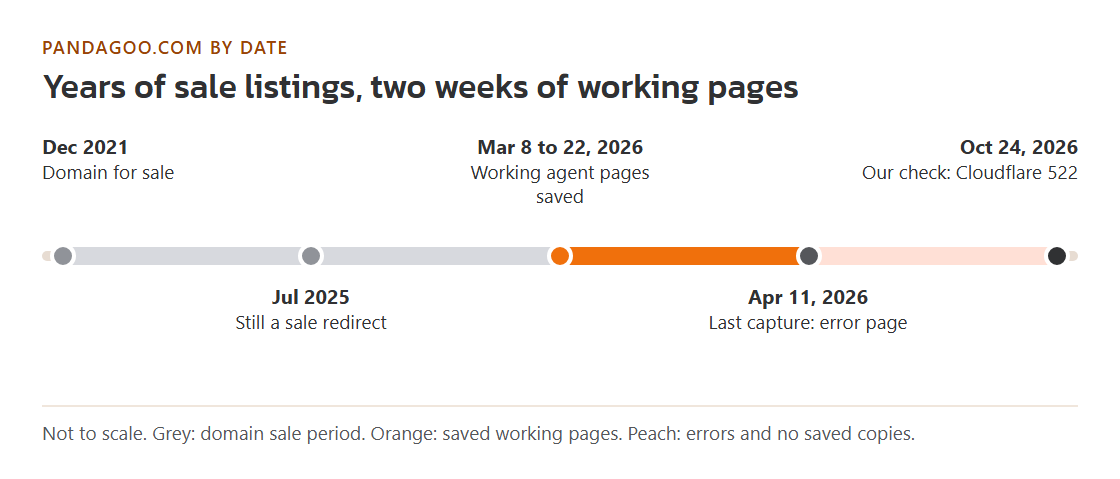
Status check on October 24, 2026: pandagoo.com forwarded to www.pandagoo.com, and that address and its sign-in page returned a Cloudflare 522 error (the server behind Cloudflare did not answer). We have not seen the site load since late March 2026. This line reports what we observed; it is not a statement about why.
Before March 2026 the pandagoo.com address showed a domain sale page; saved copies from December 2021 and March 2022 show it listed for sale, and a redirect to the same sale listing was still being captured in July 2025. Working agent pages were saved between March 8 and March 22, 2026. From March 23 the saved copies show only error pages, and the last capture we found, on April 11, is one of them. We found no closing notice and no new official address.
What we can say about Pandagoo as a service comes from that single March 8 copy of the site: the program file that held its English interface text. It described a buying service for Taobao, Weidian, 1688 and Xianyu goods with no purchasing commission, free inspection photos and 300 days of free storage. The Pandagoo page lists what the archive says and, just as important, what it never says.
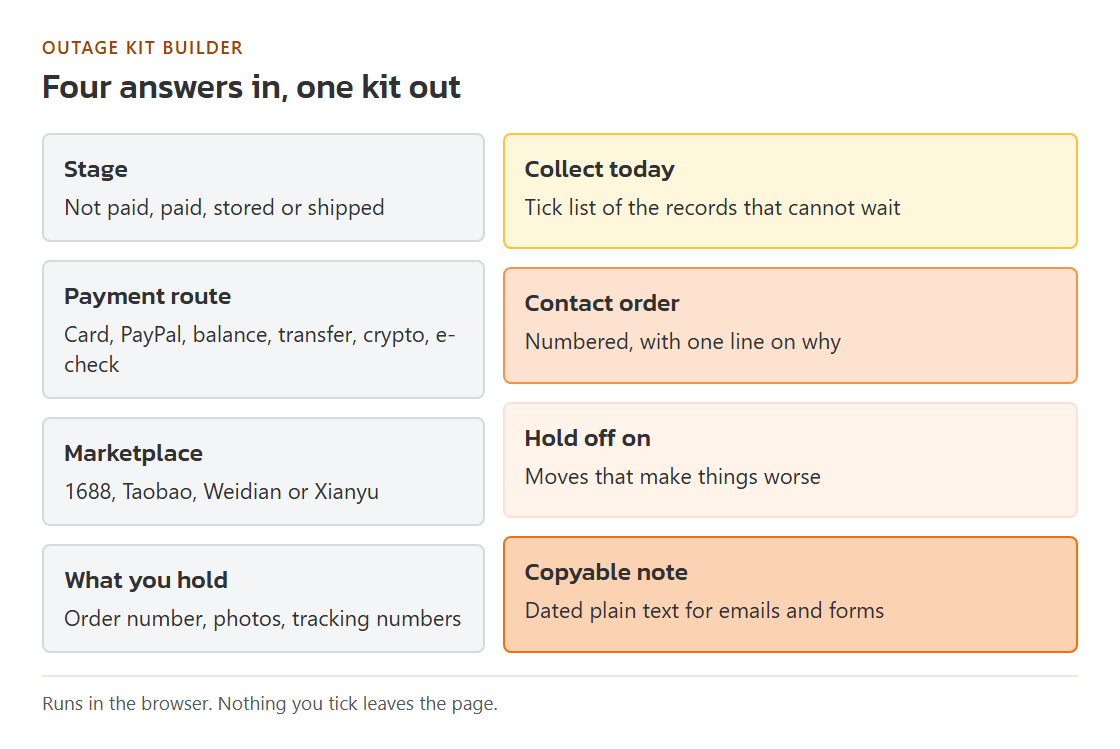
Build an order record before contacting support
Pick the stage, pick how you paid, pick the marketplace the seller was on, and tick what you still have. The builder answers with three things: a tick list of records to collect, grouped by how urgent each one is; a numbered list of whom to contact, in order, with one line on why that party comes where it does; and a plain-text note you can copy into an email or a support form. Everything happens inside your browser; nothing you choose is sent or saved. It works for any agent; Pandagoo is only the example we keep coming back to.
Start with the order reference, amount, payment date and last visible status. Keep full receipts privately; redact names, addresses and payment identifiers from public posts. The builder organises your own records and does not establish a refund entitlement or submit a claim.
How a Pandagoo order ran, for reference
Even with the site gone, its saved screens show the sequence an order went through: choose a product, verify the order details, confirm and pay, then wait for the goods to be stored in the warehouse. The archive calls that the first payment. After inspection photos, you would build a parcel, get a freight quote and settle the second payment for international shipping. Knowing the sequence tells you which screen held which record, which is the record you now need to rebuild from emails. Our guide walks the archived screens step by step and marks, at each step, what to have saved.
Background reading behind the four stages
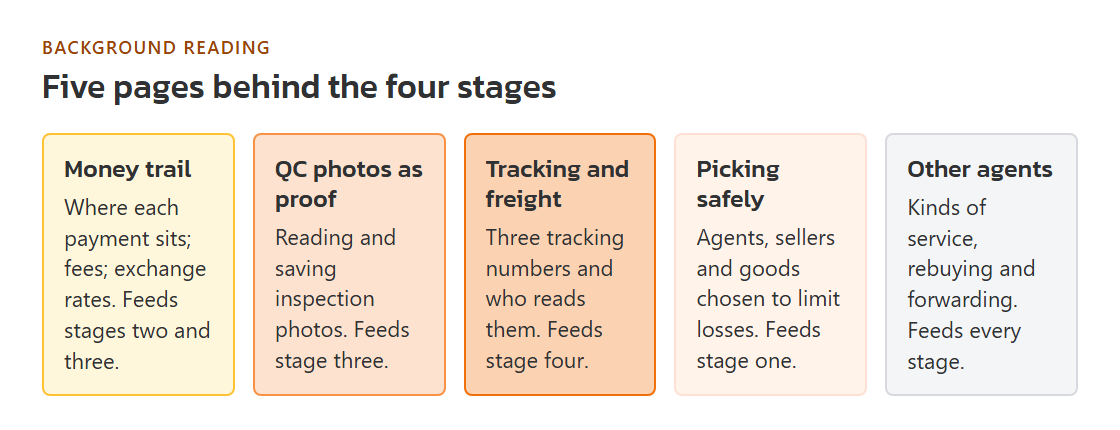
The stage pages stay short on purpose. The longer explanations live on five reading pages:
- The money trail: where each payment sits, what Pandagoo's archived fee formula meant, and why the exchange rate matters after the fact.
- QC photos as proof: reading inspection photos for defects and saving them so they still mean something later.
- Tracking and freight: how a parcel keeps moving after the agent stops, and which number unlocks which carrier.
- Picking agents, sellers and goods: choices made before you pay that decide how much you could lose.
- Other agents and moving an order: how buyers rebuy or redirect goods through a different service.
What the Lifeboat does that a plain catalogue skips
Most Spreadsheet sites are catalogues and nothing else, which is fine while every agent works. This one is kept for the other case. Every shelf card shows the listing's offer ID, because an ID survives when an agent's order page does not. Every date on the site is the date we checked, not the date the page was built. When we cannot confirm a fact we say so; the Pandagoo page has a whole section of things the archive leaves blank. Our method and our limits are on the about page, together with a short test for judging any Spreadsheet site, this one included.