
Lifeboat front page › Money trail, the page you are on now
Background reading
The money trail: where each payment sits, what it cost, and the rate it crossed at
A cost breakdown for an agent order, read the way an outage forces you to read it: by where each sum sits today and who holds the record of it.
Where your money sits on any given day
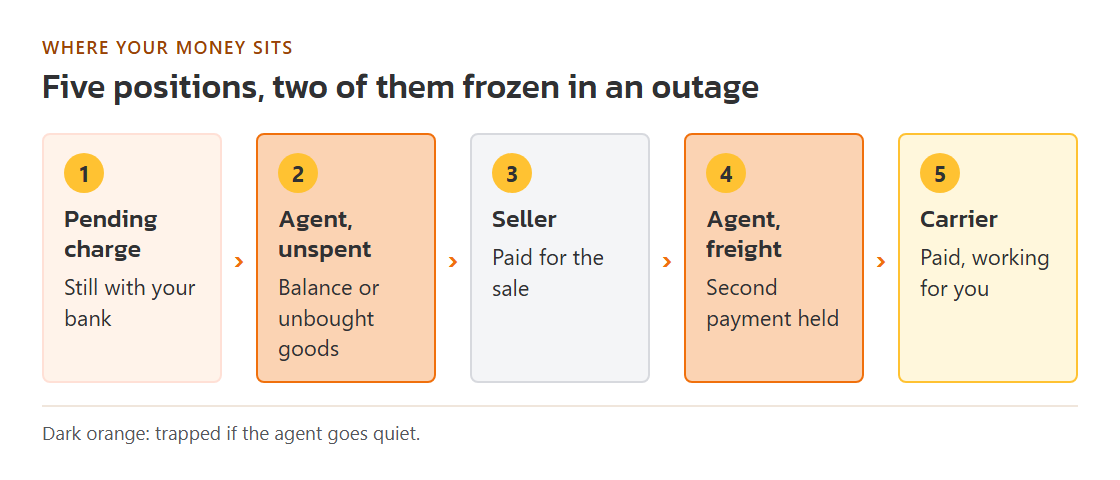
A fee table tells you what an order costs. In an outage you need something else: a map of where each sum is sitting today. An agent order splits your money into pieces that travel separately.
- In your account, held. Some card payments show as pending for a few days. A pending charge is still between you and your bank.
- With the agent, unspent. A topped-up balance, or a payment for goods the agent has not yet bought. The agent holds it.
- With the seller. Once the agent buys, the goods money goes to the seller through the marketplace. It now belongs to that sale.
- With the agent, for freight. The second payment, held until a carrier is paid for your parcel.
- With the carrier. Paid out once the parcel ships.
Pieces two and four are the ones an outage traps. Piece one is still your bank's business, so ask it early. Piece three is spent but traceable through the seller. Piece five is spent and working for you. Write down which piece each of your payments is in; it decides the order of contacts on the outage kit page.
The fee formula Pandagoo printed, worked through
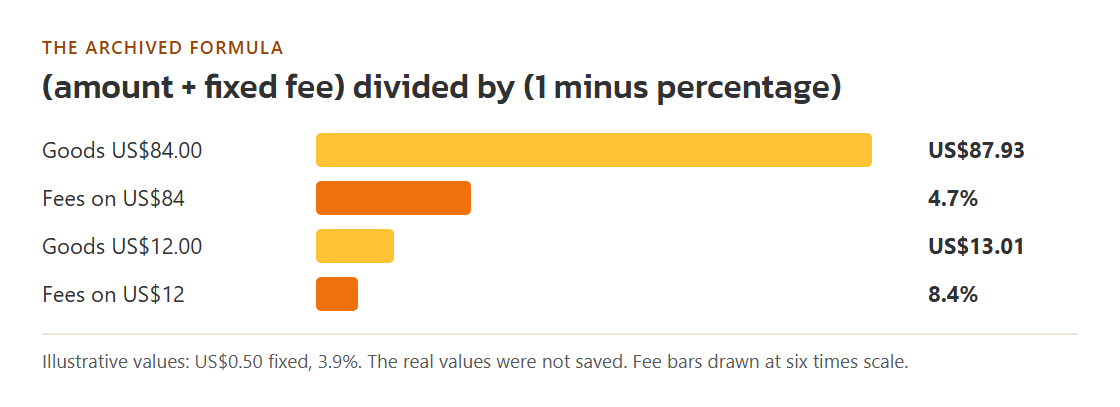
Pandagoo's saved text gives the formula for every payment but not its two values. It takes the amount due, adds a fixed handling fee in US dollars, then divides by one minus a percentage fee. Dividing, rather than multiplying, means the percentage is charged on the total including itself, so the real rate is a little above the printed one.
To see the effect, take made-up values of US$0.50 fixed and 3.9% (the archive does not give the real ones). Goods of US$84.00 become 84.50 divided by 0.961, which is US$87.93: fees of US$3.93, or 4.7% of the goods. A small payment of US$12.00 becomes US$13.01, fees of US$1.01, or 8.4%. The fixed part weighs most on small payments.
For an outage this matters in one way: the amount on your card statement is the formula's result, not the goods price. When you list the amount you paid for a dispute or a claim, use the statement figure, and keep the goods price beside it so the difference is explained.
Charges stacked on one parcel bill
Pandagoo promised no purchasing commission. Most agents charge something, and the lines differ more in name than in kind. A cost breakdown for one parcel usually has these parts:
- The goods price on the listing, and the seller's domestic shipping to the warehouse.
- A service fee on purchases, either a percentage or nothing at all.
- A payment handling fee for the route you pay by, which is what Pandagoo's formula covers.
- Optional extras such as extra photos, special packing or insurance.
- International freight, priced by weight or by volume, whichever is greater.
- Import duty and handling in your country, charged by the carrier or postal service, not by the agent.
Only the last one is out of the agent's hands. The others pass through the agent, which is why they can be caught in an outage.
The exchange rate after the fact
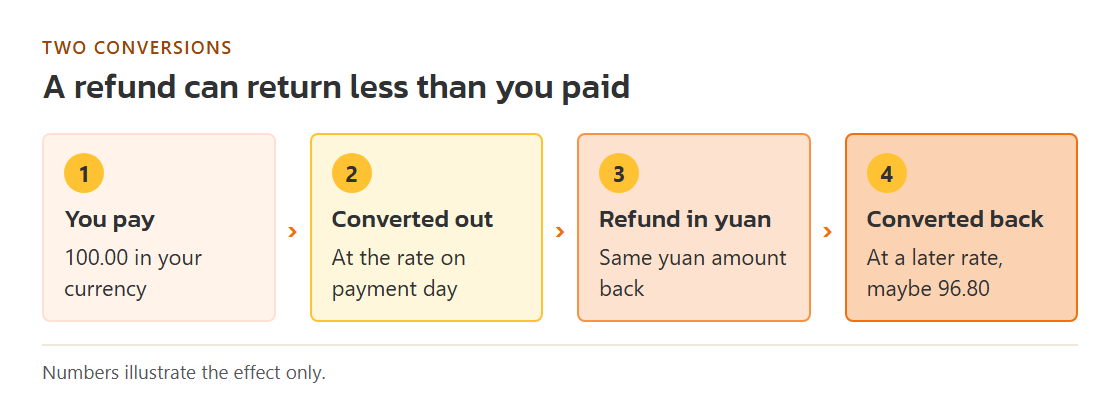
Exchange rates matter twice in an outage. When you paid, the agent, your card network or PayPal converted your currency into yuan or dollars at some rate, often with a margin. If money ever comes back, the conversion runs the other way at a different day's rate, possibly with another margin. A refund of exactly what you were charged in yuan can arrive as less than you paid in euros or pounds.
Pandagoo's saved text says incoming bank transfers were converted to yuan at the site's own rate on the day the money arrived, and that it did not accept yuan sent from abroad. If you paid by transfer, the amount the agent credited may differ from the amount your bank sent. Your bank's confirmation shows what left; only a screenshot of the agent's recharge record would show what arrived. Keep both if you have them.
Prepaid balances as the clearest exposure
A prepaid balance is convenient and, in an outage, the clearest exposure. The saved Pandagoo screens include a top-up history, a withdrawal history, a "Balance withdrawal" screen and an "Account balance" figure. Refunds for cancelled orders and returned goods went to that balance, not to your card. So a refund you were promised may now be a number on a screen you cannot open.
Two habits limit this with any agent: top up only what the next payment needs, and withdraw refunds as they land rather than leaving them for the next order.