
Lifeboat front page › Outage kit builder, the page you are on now
Tool
Outage kit builder: a checklist and contact order for one stuck order
Four inputs, one result: the records to gather, the people to contact in order, and a dated note you can paste anywhere. It works for any agent.
Outage kit builder
Your kit appears here
Choose a stage and a payment route, then press the button. The list is built in your browser; nothing is sent or stored.
Working through the builder, field by field
This is how to use the tool, one field at a time.
Stage. Pick the position the order was in when the site stopped answering, not where you hoped it was. If you do not know, open "Not sure which stage" and tick what you can find in your own records. The form places the order for you using the same four questions as the stage overview.
How the money was paid. This decides who holds your payment record and who you ask about it. A balance top-up counts as paid even when the order itself was not, so the builder treats it that way.
Where the seller listed the goods. This changes two lines: which ID to save for each product, and how to reach the seller if you need to ask whether something shipped. On 1688 that ID is the offer number; on Taobao and Weidian it is the item ID in the link.
Things you still have. Ticking a box moves that record from "find it" to "copy it". Leaving one unticked adds a line telling you where people usually find it.
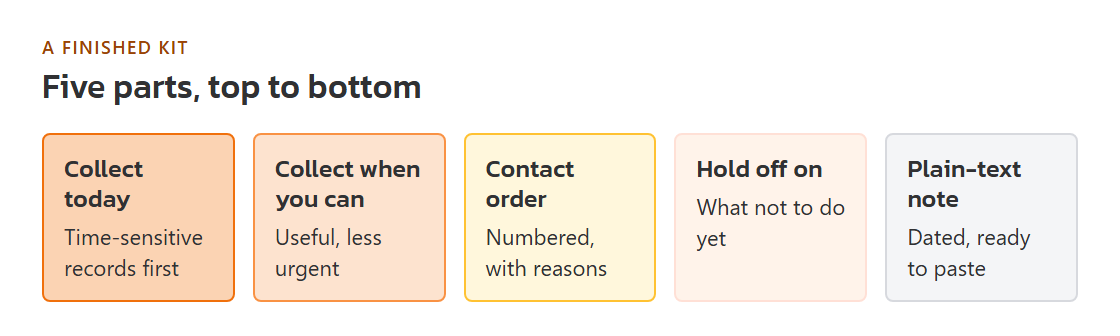
The answer comes in four parts: what to collect today, what to collect when you can, whom to contact in order, and what to hold off on. Below that is a plain-text note with today's date, ready to paste into an email or a provider's form. The tick boxes are for your own progress; they reset if you reload.
Why the contact order moves with the payment route
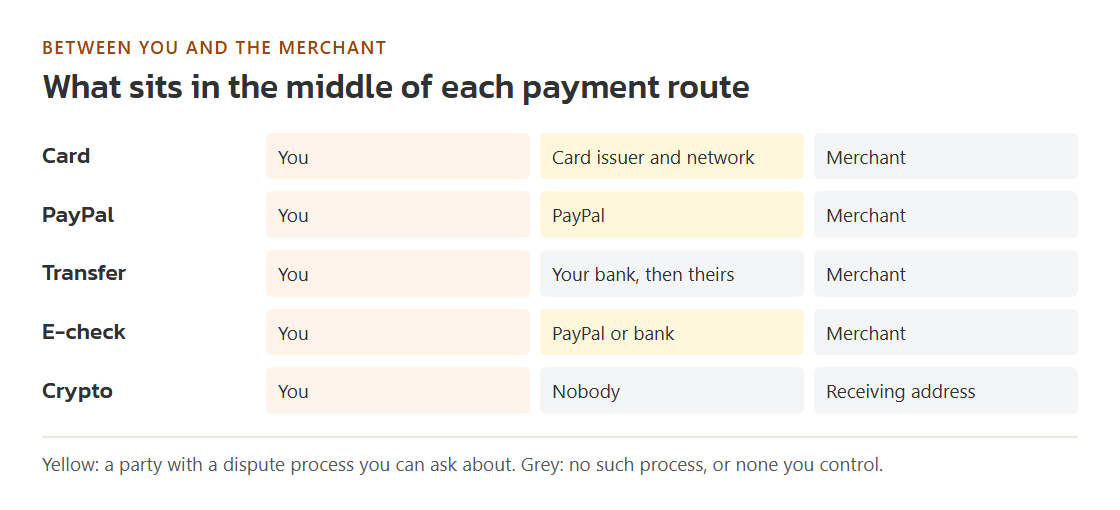
The order of contacts is the part people get wrong most often, usually by writing to the agent for weeks and only then asking whoever holds the payment. The builder puts the payment holder second at stages two and three for a reason: processes for reversing or disputing a payment usually carry a time limit, and that limit does not pause while you wait for an agent's reply.
The route then changes what that second contact can do. A card issuer or PayPal sits between you and the merchant, so there is a process to ask about. A bank transfer has no merchant process in the middle; your bank can only tell you whether a recall or trace is possible. A cryptocurrency transfer has nobody in the middle at all, so the useful record is the transaction hash and the receiving address, and the party to tell is the exchange you sent from. The builder does not predict any outcome. It lines up the records each party usually asks for.
What the builder does not know
- It does not know your provider's time limits. They differ between card networks, issuers, PayPal account types and countries; ask.
- It does not know whether the agent will come back. Nothing on this site predicts that, for Pandagoo or anyone else.
- It cannot see your accounts. It reads only the boxes you tick, and it forgets them when you close the page.
- It is not advice about what you are owed. It is a list of records and contacts, ordered so the time-sensitive ones come first.
If a line in your kit looks wrong for your case, tell us at the address in the footer. Corrections go into the change record with a date.
Read on from here