
Lifeboat front page › Picking agents, sellers and goods, the page you are on now
Background reading
Picking agents, sellers and goods with an outage in mind
The choices made before the first payment decide how much an outage can cost. How to choose an agent, a seller and the item itself so that losses stay small and recovery stays easy.
An agent whose failure you could absorb
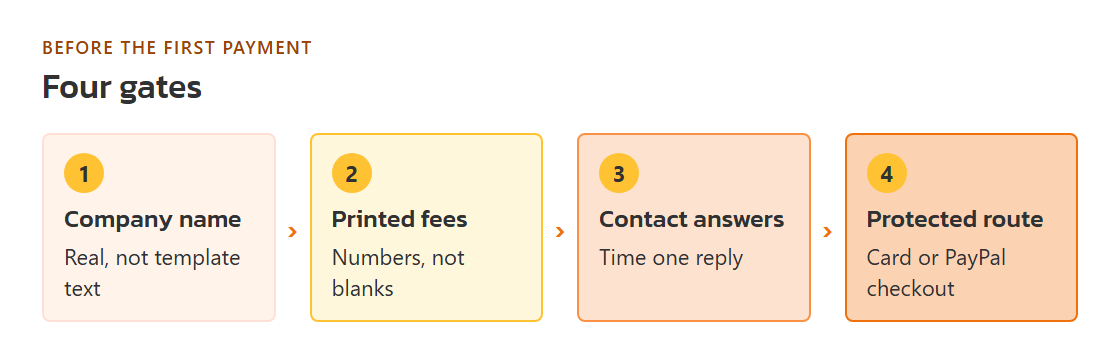
Most advice on how to choose an agent asks whether it is cheap and fast. This page asks a different question: if this agent went quiet tomorrow, how much would you lose and how hard would it be to recover? A trustworthy agent is one where the answers are small and easy. Four checks get you most of the way, and you can run them before paying anything.
- Can you name the company? Look for a legal company name and an address on the terms page, and check the name is not template text. Pandagoo's saved terms carry a template company name, which is a warning sign by itself.
- Are the fee values printed? A formula with blanks, as in Pandagoo's case, means you cannot check your own bill.
- Does a contact answer? Send one precise question before your first payment and time the reply.
- Do the payment routes have someone in the middle? Card and PayPal checkouts come with a dispute process; bank transfers and crypto do not.
Keeping less of your haul in flight
Long free storage is sold as a benefit: buy slowly, ship once. It also means more of your money sits inside one agent for longer. Pandagoo offered 300 days. A buyer who used them fully would have had months of purchases in its warehouse when the site stopped.
Three habits keep the amount in flight small. Ship in smaller parcels more often, accepting a little more freight per kilo. Top up a balance only for the payment in front of you. And spread big hauls over two agents if you can, so neither holds everything.
Choosing a seller who can still be found
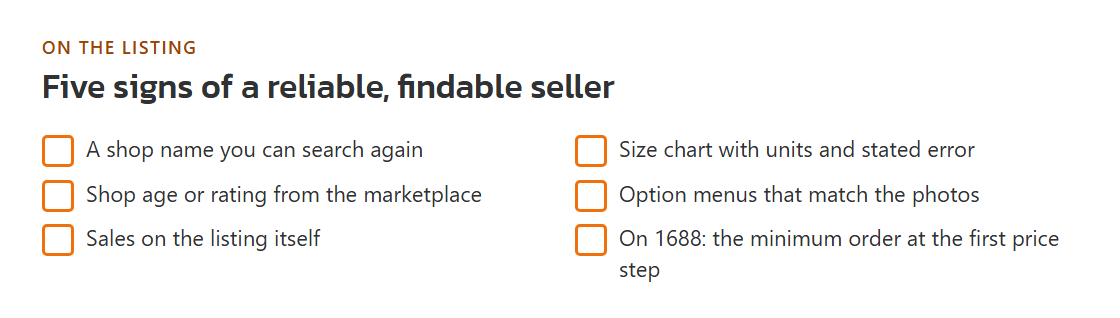
Good sellers matter twice. A reliable seller ships what was ordered, which keeps the order out of trouble; a findable seller can be asked what happened to it if the agent goes quiet. When vetting sellers, look for these signs on the shop page:
- A shop name you can search for again, and a shop age or rating shown by the marketplace.
- Sales records on the listing itself, not only on the shop.
- A size chart with units and a stated measuring error.
- Option menus that match the photos. Menus that mix in other products, gift boxes or bundle counts are a sign to slow down.
- For 1688 suppliers, the minimum order: the first price step shows how many pieces the quoted price needs.
Goods you could replace within a day
When picking the item itself, prefer goods with many near-identical listings: a plain hoodie, a canvas sneaker, a cotton cap. If an agent fails, you can buy the same thing through another service in minutes. One-off goods, such as second-hand items on Xianyu or a seller's limited batch, cannot be replaced, so they are the ones to buy through an agent you already trust. The same logic applies to shipping: goods without batteries, liquids or magnets travel on ordinary lines and rarely hold a parcel back.
Before you pay, every time
- Copy the listing link and the item or offer ID into your own notes.
- Write your option choices in words.
- Check the agent's site loads, its contact answered, and its fee values are printed.
- Pay by a route with a dispute process if you have the choice.
- Keep the receipt in a folder named after the order number.
None of this is specific to Pandagoo. These are the mistakes that make an outage expensive, avoided in advance.